
Description
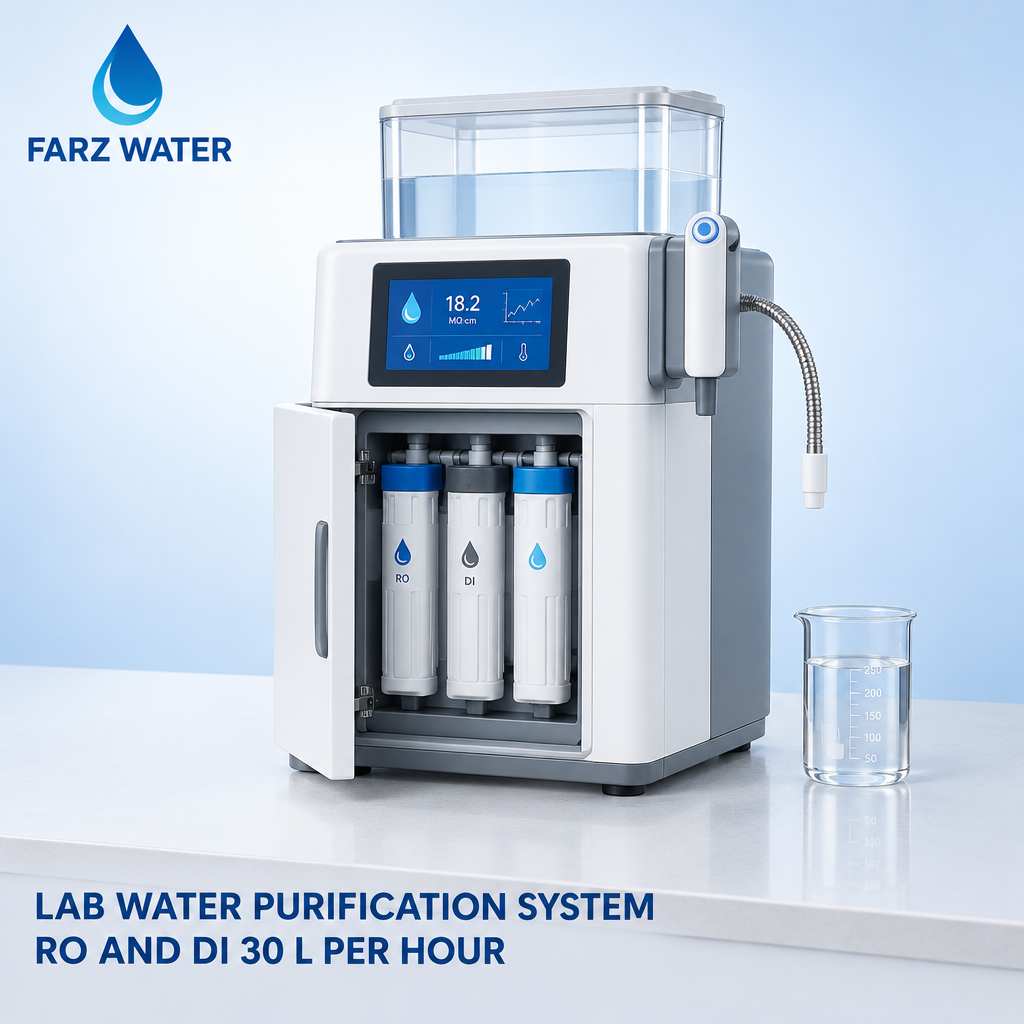
Laboratory water purification system Oman — a benchtop RO and DI unit producing 30 litres per hour of Type II and Type III laboratory water, with a polishing stage for Type I at the point of dispense. It supplies reagent preparation, glassware rinsing, autoclaves, analysers and media preparation from a single unit on the bench.
Water grades and what they mean
Laboratory water is graded by resistivity and organic content, defined in ISO 3696 and in the equivalent ASTM and CLSI standards. Specifying the wrong grade is the most expensive mistake in a laboratory water purification system Oman buyers make, in both directions.
- Type III, above 0.05 megohm-cm, from RO alone. Glassware rinsing, water baths, autoclave feed.
- Type II, above 1 megohm-cm, RO followed by DI. General reagent preparation, buffer solutions, media.
- Type I, 18.2 megohm-cm with low TOC, polished at the point of use. HPLC, ICP-MS, molecular biology, trace analysis.
Type I cannot be stored. It picks up carbon dioxide and leaches from any container within minutes, which is why it is polished as it is dispensed rather than held in a tank.
How the laboratory water purification system Oman labs need is configured
Feed water passes through pretreatment cartridges, then an RO membrane which removes 95 to 99 percent of dissolved salts and most organics and particulates. The permeate is stored in the reservoir as Type III. On demand, it passes through mixed bed DI resin and, where Type I is required, a final polishing pack with a 0.22 micron filter and optional UV at 185 and 254 nanometres for TOC reduction.
The touchscreen displays live resistivity, so you can see the grade being dispensed rather than assume it.
Laboratory water purification system Oman: feed water changes the sizing
Lab water systems are specified on the assumption of municipal feed around 200 to 400 ppm TDS. Much of Oman runs well above that, and on borewell or tanker supply it can exceed 1,500 ppm.
Higher feed TDS means the RO stage passes more salts, so the DI pack does more work and exhausts faster. A unit specified on European assumptions can burn through consumables three times faster here. Where feed TDS is high we fit pretreatment ahead of the unit, which costs less than the extra cartridges within the first year.
Specification
- Output 30 litres per hour, Type I, II and III from one unit
- Type I at 18.2 megohm-cm at 25 degrees, TOC below 10 ppb with UV option
- Integrated reservoir, typically 30 to 60 litres, with vent filter
- Colour touchscreen with live resistivity and TOC display
- Cartridge life and sanitisation reminders
- 0.22 micron final filter on the dispense arm
- Benchtop or wall-mounted, 220 V
Laboratory water purification system Oman consumables and validation
Pretreatment cartridges are changed every 6 to 12 months, DI packs on resistivity rather than on a calendar, and the final filter every 3 to 6 months. The reservoir is sanitised at each major service, because a reservoir of ultrapure water with a vent filter is exactly where biofilm establishes if left.
For accredited labs we provide the calibration and service records that auditors ask for. If your lab is working to ISO 17025, tell us at quotation stage so the documentation is set up from commissioning rather than reconstructed later.
Related equipment
For larger central supply feeding several rooms, a 250 LPH RO plant with a loop and point-of-use polishing is more economic than multiple benchtop units. Replacement DI resin cartridges and UV disinfection for the distribution loop are stocked locally.
Request a quotation
Tell us which water grades you need, your daily volume and your feed source, and we will configure the system, quote consumables for the first year, and include pretreatment if your feed water requires it. We supply hospitals and laboratories across Oman. Call +968 9455 4533 or request a quote.

Reviews
There are no reviews yet.