
Description
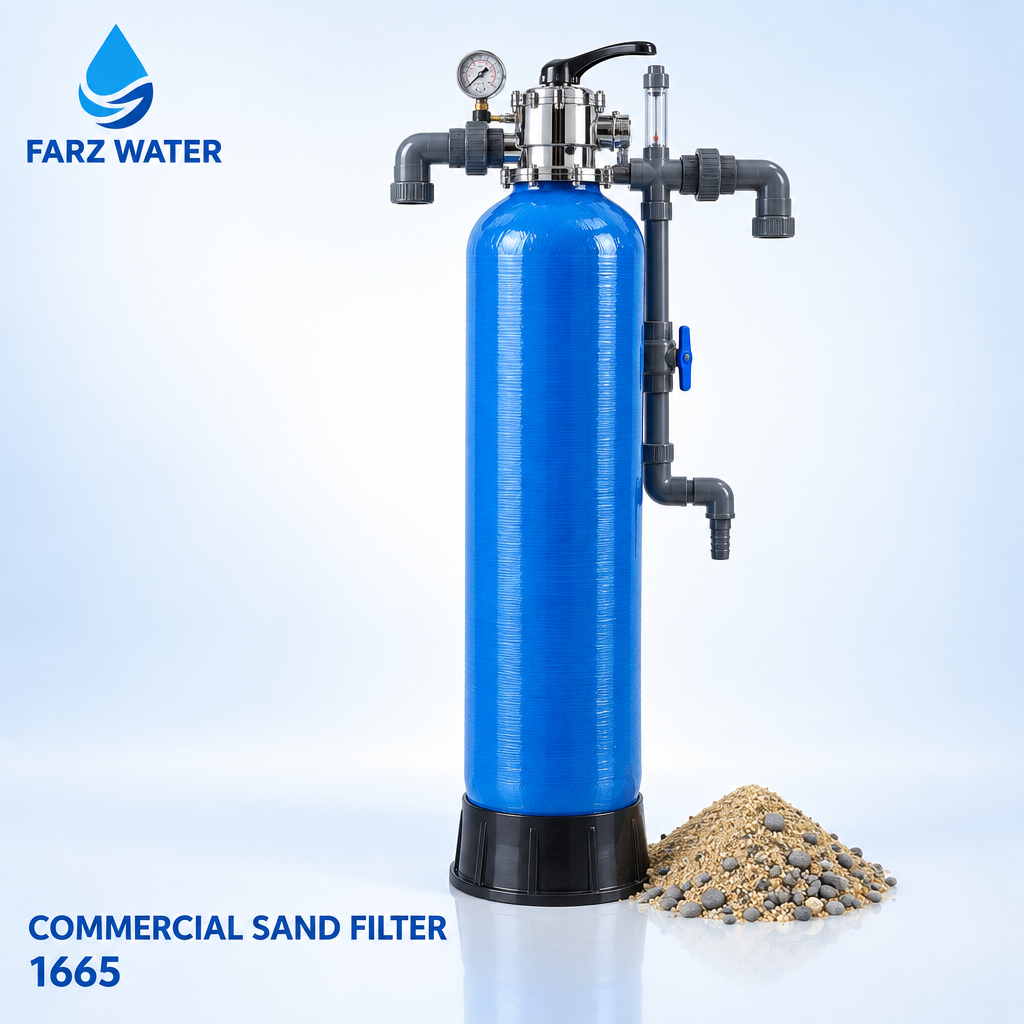
Sand filter Oman — the 1665 commercial multimedia filter is the first vessel in almost every treatment train we install. It strips suspended solids, turbidity and silt down to around 20 microns so that everything downstream, softener, membranes and dosing, works on water it can actually handle.
What a sand filter Oman sites install actually removes
Water passes downward through graded layers: fine anthracite on top, then filter sand, then coarse garnet or gravel supporting the bed. Larger particles are caught in the upper layer, progressively finer ones deeper down. This graded arrangement holds far more dirt before blinding than a single-grade sand bed.
Expect turbidity reduction to below 1 NTU from typical Omani feed, and removal of sand, silt, rust and the fine particulates that tanker deliveries bring. It does not touch dissolved salts, hardness or bacteria. Those are jobs for a softener, an RO plant and a disinfection step respectively.
Why it matters before RO
RO membranes are specified with a maximum feed SDI, usually 5 or below. Feed water above that fouls the element regardless of antiscalant, and a fouled membrane is an expensive lesson. The SDI limits for each element are published in the DuPont Water Solutions technical resources. The sand filter is what brings SDI into range.
The same applies to a softener. Silt reaching a resin bed channels the flow, so part of the bed is never used and the softener underperforms at full salt cost.
Sizing on flow, not on tank size
A filter is sized on service flow velocity, not on how big the vessel looks. The working range is 12 to 20 cubic metres per hour per square metre of bed area.
The 1665 vessel has about 0.13 square metres of bed, giving a comfortable service flow of roughly 1.6 to 2.6 cubic metres per hour. Push it past that and the bed channels: water finds a fast path through and leaves unfiltered. Undersizing a sand filter Oman installations need is the most common design error we are asked to correct, and it shows up as an RO plant fouling repeatedly for no obvious reason.
Backwashing
The bed must be backwashed to lift and rinse out what it has trapped, typically every two to three days depending on load. Backwash needs a higher flow than service, around 25 to 30 cubic metres per hour per square metre, and it goes to drain.
Two consequences to plan for. You need a drain able to take that flow, and you lose that water. On a site where every litre is trucked in, backwash volume belongs in the budget from the start rather than as a surprise in month two.
Specification
- 16 by 65 inch FRP pressure vessel, rated to 10 bar
- Graded media: anthracite, filter sand, garnet and support gravel
- Automatic or manual multiport backwash valve
- Service flow to approximately 2.6 cubic metres per hour
- Inlet and outlet 1 inch, separate drain connection
- Pressure gauges on inlet and outlet, sight glass on the backwash line
Media life
Media is not consumed, but it degrades. Anthracite attrits and the fines wash out, and over five to seven years the bed loses depth and grading. Topping up is not the same as replacing: the grading is what makes the filter work. We replace the full bed rather than adding to a tired one.
Where it fits
First in line after the raw water tank, ahead of the commercial water softener and the antiscalant dosing system, protecting the 250 LPH RO plant or larger. Where iron is also present, an iron removal filter handles that separately.
Request a quotation
Send your peak flow and a water analysis and we will size the vessel, specify the media and quote installed with the backwash drain. Call +968 9455 4533 or request a quote.


Reviews
There are no reviews yet.