Description
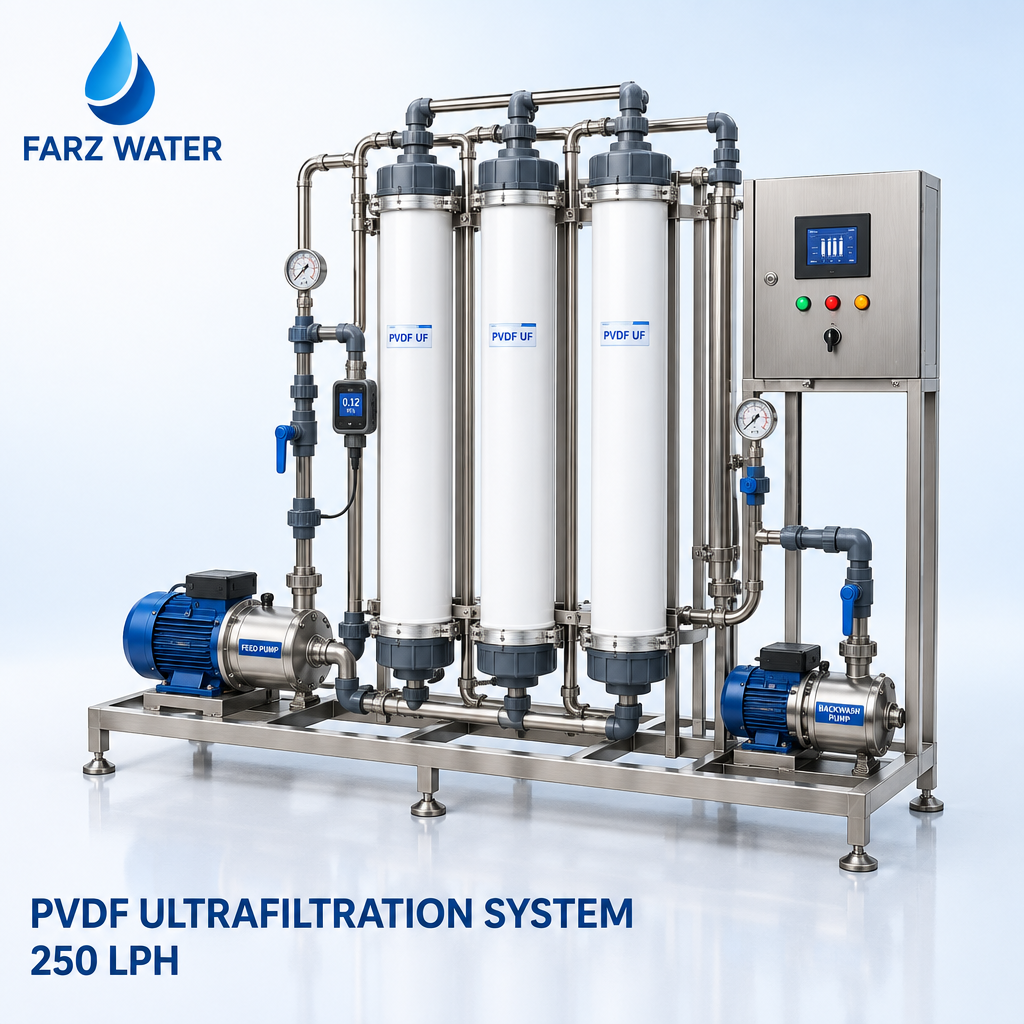
Ultrafiltration system Oman — a 250 LPH PVDF hollow fibre skid that removes suspended solids, colloids, bacteria and viruses by physical size exclusion, with no chemicals and no salt removal. It is the right choice where the water is microbiologically unsafe but the dissolved salts are already acceptable.
Ultrafiltration system Oman applications where RO is the wrong tool
RO removes everything, which is not always what you want. It strips beneficial minerals, wastes water to reject, needs high pressure and demands careful pretreatment.
Where feed TDS is already below 500 ppm, as on much of the treated municipal supply in Muscat, UF gives you safe water at a fraction of the running cost. Typical cases are mosque and school drinking supply on good mains water, borewell water that is low in salts but high in turbidity, tank water that needs a microbiological barrier, and pretreatment ahead of a downstream RO plant.
What the membrane actually does
PVDF hollow fibres carry pores around 0.02 to 0.03 microns. Anything larger cannot pass. That is an absolute physical barrier, not an adsorption process that gradually saturates.
- Bacteria, at 0.5 to 5 microns, removed to better than 6 log
- Viruses, at 0.02 to 0.4 microns, removed to 4 log or better
- Protozoan cysts including Giardia and Cryptosporidium, removed completely
- Colloids, silt and turbidity, reduced to below 0.1 NTU
- Dissolved salts, hardness and fluoride, not removed at all
The removal levels sit comfortably inside the microbiological targets in the WHO drinking water guidelines.
Ultrafiltration system Oman: why PVDF rather than PES
PVDF tolerates chlorine and aggressive cleaning far better than the alternatives. On an Omani installation the membrane will be chemically cleaned regularly and often sees chlorinated feed, and a PES fibre degrades under both. The material choice is what decides whether the module lasts five years or eighteen months.
Ultrafiltration system Oman backwash and cleaning
UF is not a fit-and-forget cartridge. The fibres are backwashed automatically every 20 to 60 minutes, a cycle lasting under a minute, which lifts the accumulated cake off the fibre surface. Roughly monthly, a chemically enhanced backwash with caustic and hypochlorite removes organic fouling, and an acid clean removes inorganic scale.
The skid does this on its own. What it needs from the building is a drain and a power supply, and from you, the cleaning chemicals on schedule.
Specification
- Capacity 250 litres per hour, larger modules available to 500 LPH and above
- PVDF hollow fibre modules, nominal 0.02 to 0.03 micron
- Stainless steel skid with feed and backwash pumps
- Automatic backwash and CEB sequencing via PLC
- Inlet strainer, pressure gauges and turbidity monitoring
- Operating pressure 1 to 3 bar, far below RO
- Recovery typically 90 to 95 percent
UF, RO or UV
UF removes organisms physically and leaves minerals; UV disinfection inactivates organisms but removes nothing and leaves dead cells in the water; an RO plant removes dissolved salts as well but costs more to run and wastes more water. On high-TDS feed, UF is used as pretreatment ahead of RO, where it replaces a sand filter and delivers far lower SDI to the membranes.
Request a quotation
Send a water analysis with TDS, turbidity and any microbiological results, plus your daily demand, and we will confirm whether UF alone is sufficient or whether RO is genuinely needed, then quote accordingly. Call +968 9455 4533 or request a quote.


Reviews
There are no reviews yet.